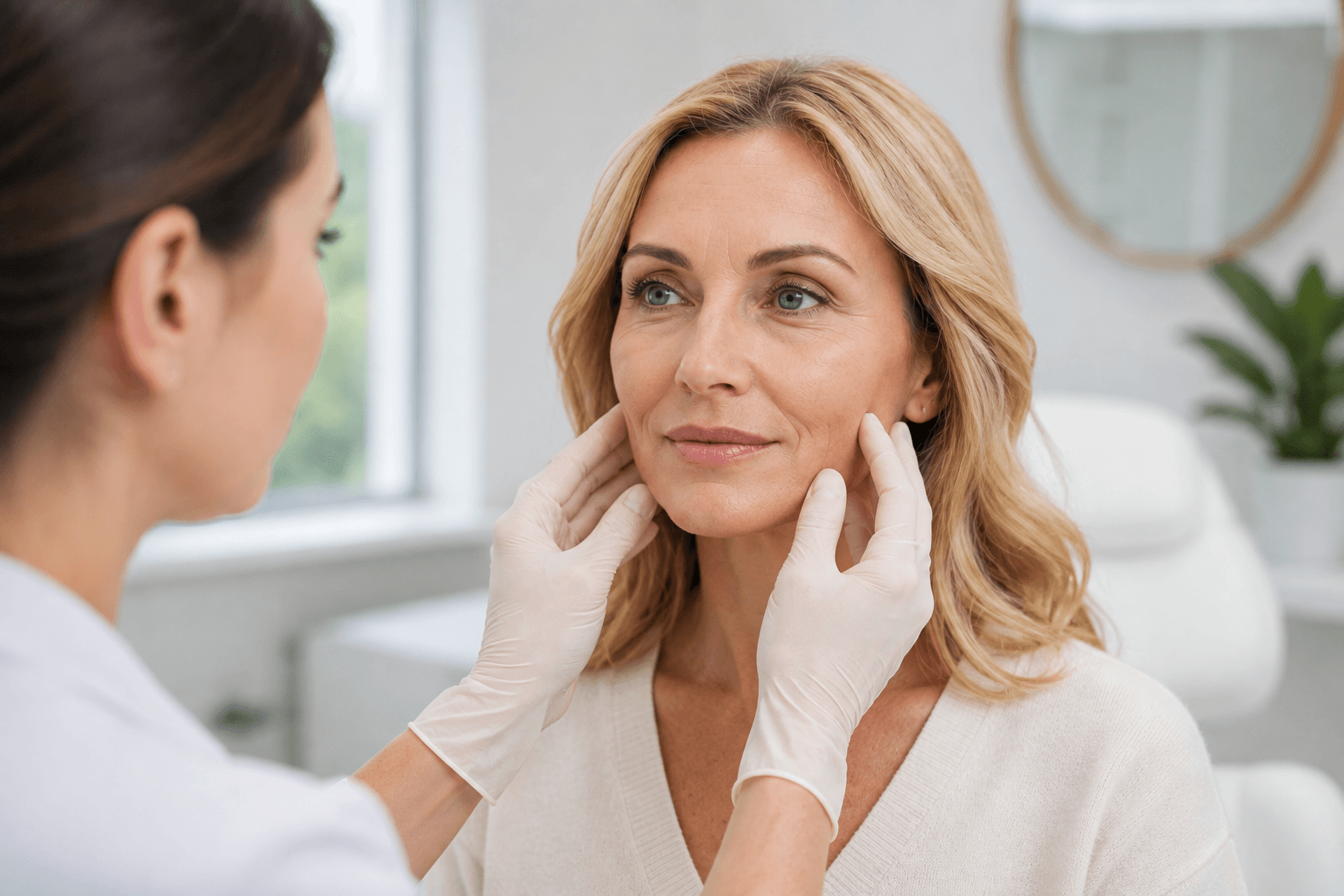
Somewhere around your late twenties or early thirties, you might catch your reflection in a certain light and think, "something looks different, but I can't quite place it." It's not usually a wrinkle. It's something quieter than that. Your cheeks might not sit as high as they used to. The area under your eyes might look a little hollow, even after a full night's sleep. The corners of your mouth might seem to droop just slightly, giving your face an expression you didn't intend.
This isn't your imagination, and it isn't necessarily about wrinkles at all. What you're likely noticing is volume loss, one of the earliest and most overlooked signs of facial aging. At Elite Medspa in Needham, Massachusetts, we talk to patients about this all the time, because understanding what's actually happening beneath the surface makes it so much easier to choose the right solution. That's where dermal filler comes in, not as a way to change your face, but as a way to gently restore what time has quietly taken away.
This article walks through why volume loss happens, how to recognize it, how it differs from the kind of aging that neurotoxin treats, and how filler works when it's done with a light, structural hand rather than a heavy one.
Facial aging isn't just about skin. Underneath the skin, your face is made up of layers of fat pads, muscle, and bone, all of which shift over time.
Your face contains distinct pockets of fat that give it a youthful, rounded contour. Starting in your late twenties and continuing steadily through your thirties and forties, these fat pads begin to shrink and, in some cases, shift downward. This is a big part of why cheeks that once looked full can start to look flatter or slightly sunken.
Collagen and elastin are the proteins responsible for keeping skin firm and resilient. Production naturally slows with age, which means skin has less structural support sitting on top of that shrinking fat layer. The result is a face that looks less "lifted" even before any noticeable wrinkles appear.
It's easy to forget that bone changes with age too. The bones around the eye sockets, cheeks, and jaw can lose density over time, which removes some of the underlying scaffolding your face relies on. This is part of why under-eye hollowing and a less defined jawline tend to become more noticeable in your forties and beyond.
Some people lose volume earlier or more noticeably than others due to genetics, and factors like sun exposure, smoking, and significant weight fluctuations can accelerate the process.
Volume loss can be subtle at first, which is why it's often mistaken for "just looking tired." Common signs include:
If several of these sound familiar, it's worth understanding the difference between this type of aging and the kind caused by muscle movement, because they call for two very different approaches.
This is one of the most common points of confusion we address at Elite Medspa, and it's an important one, because it determines which treatment will actually help you.
Dynamic wrinkles are caused by repeated muscle movement, think the lines that form between your brows when you frown, across your forehead when you raise your eyebrows, or around your eyes when you smile. These are best addressed with a neurotoxin treatment, which temporarily relaxes the muscle responsible for the movement.
Volume loss, on the other hand, has nothing to do with muscle activity. It's about structural changes: less fat, less collagen, less bone density. No amount of muscle relaxation will restore volume that has genuinely diminished. This is where dermal filler plays its role, adding gentle, targeted support back into the areas that have lost it.
Many of our Needham patients benefit from a combination approach, using neurotoxin for expression lines and filler for volume, but the two treatments are solving different problems, and it helps to know which one you actually need.
Dermal filler is an injectable gel formula designed to restore lost volume and gently reshape areas of the face that have flattened or hollowed with age. At Elite Medspa, we offer a range of filler options, including our natural EZ Gel formula, which is designed to integrate smoothly with your own tissue for a soft, natural feel and appearance.
When injected by a skilled provider, dermal filler adds subtle structure beneath the skin, lifting areas that have descended, softening shadows and hollows, and smoothing the transitions between different parts of the face. The gel formulas we use are designed to move and feel like natural tissue, which is a big part of why the results look like you, simply refreshed.
You can learn more about our approach on our dermal filler service page or explore the specifics of our natural EZ Gel filler option.
Dermal filler is remarkably versatile because it can be tailored to whatever area needs support. Common treatment areas include:
Every face ages differently, which is exactly why a personalized consultation matters so much more than a one-size-fits-all treatment plan.
Most healthy adults noticing early to moderate volume loss are good candidates for filler. You might be a strong candidate if you're seeing flattened cheeks, under-eye hollowing, thinning lips, or softened jawline definition, and you want a non-surgical way to address it.
That said, filler isn't right for everyone. Patients who are pregnant or breastfeeding, have certain autoimmune conditions, or have active skin infections in the treatment area are typically advised to wait or explore alternatives. A consultation with one of our injectors, Heidi Rodriguez, DNP, WHNP-BC, RN, or Caroline Reynolds, PA-C, is the best way to determine if filler is appropriate for your goals and health history. Both work under the guidance of medical director Dr. Joelle Lieman.
At Elite Medspa, we believe the best filler results don't come from adding more, they come from understanding your facial structure. Our approach is rooted in our philosophy of "Science-led Beauty. Nature-based Wellness," which means we treat with restraint and precision rather than volume for volume's sake.
The goal is never to change how you look. It's to soften the visible signs of volume loss so that people simply notice you look refreshed, well rested, and like yourself again. This is especially true with our lip treatments: people don't see fuller lips, they simply notice that you look refreshed. That subtlety is intentional, and it's a big part of why so many Needham, Massachusetts patients return to us for their ongoing care.
A dermal filler appointment at our Needham office typically takes between 30 and 60 minutes, depending on how many areas are being treated. Most patients describe the sensation as a light pinch or pressure rather than significant pain, and our injectors use techniques designed to keep you comfortable throughout.
Afterward, you may notice mild swelling or slight bruising at the injection sites, which typically resolves within a few days. Results are visible almost immediately, with any residual swelling settling within one to two weeks to reveal the final look.
Depending on the treatment area, formula used, and your individual metabolism, results generally last anywhere from six months to two years. Areas with more movement, like the lips, tend to metabolize filler more quickly than areas like the cheeks. Your provider will walk you through realistic expectations for your specific treatment plan during your consultation.
As of this August, our team continues to update our treatment protocols to reflect the latest advances in filler formulation and injection technique, so patients visiting us in 2026 are benefiting from some of the most refined approaches available.
Does dermal filler hurt? Most patients describe the discomfort as minimal, often just a brief pinch or pressure. Many filler formulas also contain a numbing agent to improve comfort during treatment.
How long does filler last? Results typically last between six months and two years, depending on the treatment area and the specific formula used.
What's the difference between filler and tox? Filler restores lost volume caused by structural changes like fat and collagen loss, while neurotoxin relaxes the muscles responsible for expression lines. They address two different causes of facial aging.
Is dermal filler reversible? Many hyaluronic acid based fillers can be dissolved if needed, which is one reason they're a popular, lower-commitment option for patients who are new to injectables.
Who should avoid filler? Individuals who are pregnant or breastfeeding, have certain autoimmune conditions, or have an active infection in the treatment area are generally advised to avoid filler until those circumstances change. A consultation helps determine what's right for you.
Can filler and neurotoxin be used together? Yes, many patients combine both treatments to address volume loss and expression lines at the same time, creating a more balanced, natural looking result.
Volume loss is a normal, universal part of aging, but understanding what's actually causing the changes you see in the mirror makes all the difference when choosing how to address them. If your concern is more about flattened cheeks, hollow under-eyes, or softened jawline definition than it is about expression lines, dermal filler is likely the tool built for the job.
At Elite Medspa in Needham, Massachusetts, we approach every filler treatment with the same guiding principle: enhance, don't overhaul. If you're curious whether filler is the right next step for you, visit our homepage to learn more about our full range of services, or explore our dermal filler page to see how we can help you look like a well rested version of yourself. You can also browse our blog for more insights on aging, skin health, and the treatments that support both.
.png)
.png)